Continued from previous post. Here we have some further conceptual adaptor design work to allow the option of a Volumex supercharger fitted on to the Wolseley Supercharge inlet manifold and belt drive coupling and shaft arrangement.


Continued from previous post. Here we have some further conceptual adaptor design work to allow the option of a Volumex supercharger fitted on to the Wolseley Supercharge inlet manifold and belt drive coupling and shaft arrangement.
We have often been asked about finishing fixings during restoration projects.
Well as a bit of a post script .. or in this case pre script! I would like to add this edit and say that recently there has been a definite change. BSF stock is being dropped from many of the suppliers, as a result, the costs are escalating hugely which gives greater strength to the first two points in the following list. It also means that for the first time, I regret we will be charging for new BSF bolts even when in small quantity. We will keep this charge at the cost price.
There are several options and our decision is taken according to budget, originality and purpose.


All of this talk of superchargers has made me supercharge "broodie".
I designed and built and raced "Mistress Quickly" 30 years ago and it was always part of my design brief to allow for later supercharging!
Now, with superchargers around us in the workshop, I began to wonder? Don't tell Mr B. who owns the Wolseley, but......


We have been measuring and designing new templates and adaptors. With the aid of some supplied sketches and our own dimensions, we can consider the possibility for the Wolseley to have an option to use a Volumex supercharger in the future. You can see that we've been using CAD to draw up the various components to carry out a test assembly and assessment within the CAD program.
The photos show the parts being drawn and also a prototype adaptor being printed on the 3D printer to give a a solid model for trial. Should we wish, this will give the possibility to present a slightly scaled up print for use as a pattern for casting of particular items. It may be more cost effective to cast rather than machining from billet.
Please note, the plastic type of material we use is created from biproduct of cereal production, it is wholly recyclable.
Further updates will follow.


On the Peugeot 401, we have been attending to some of the final steps, whilst we are waiting for pistons from the machine shop.
In preparation for fitting, all water jacket plates have been thoroughly cleaned up, ready for paint and repair if required. Shown here is one of the end plates, that also acts as a hinge point for a linkage, so not an easily replaceable part. As you can see it has had some serious corrosion over the years, resulting in pitting and breaking through in places! We have cleaned it up with a wire brush and repaired with a filling of braze in the worst of the pitting and holes, it was then cleaned up and dressed true and treated with rust killing solution. We arranged two parallel steel sections in the press to gently straighten out some of the distortion from previous repairs aswell as slight heat distortion from our braze repair.


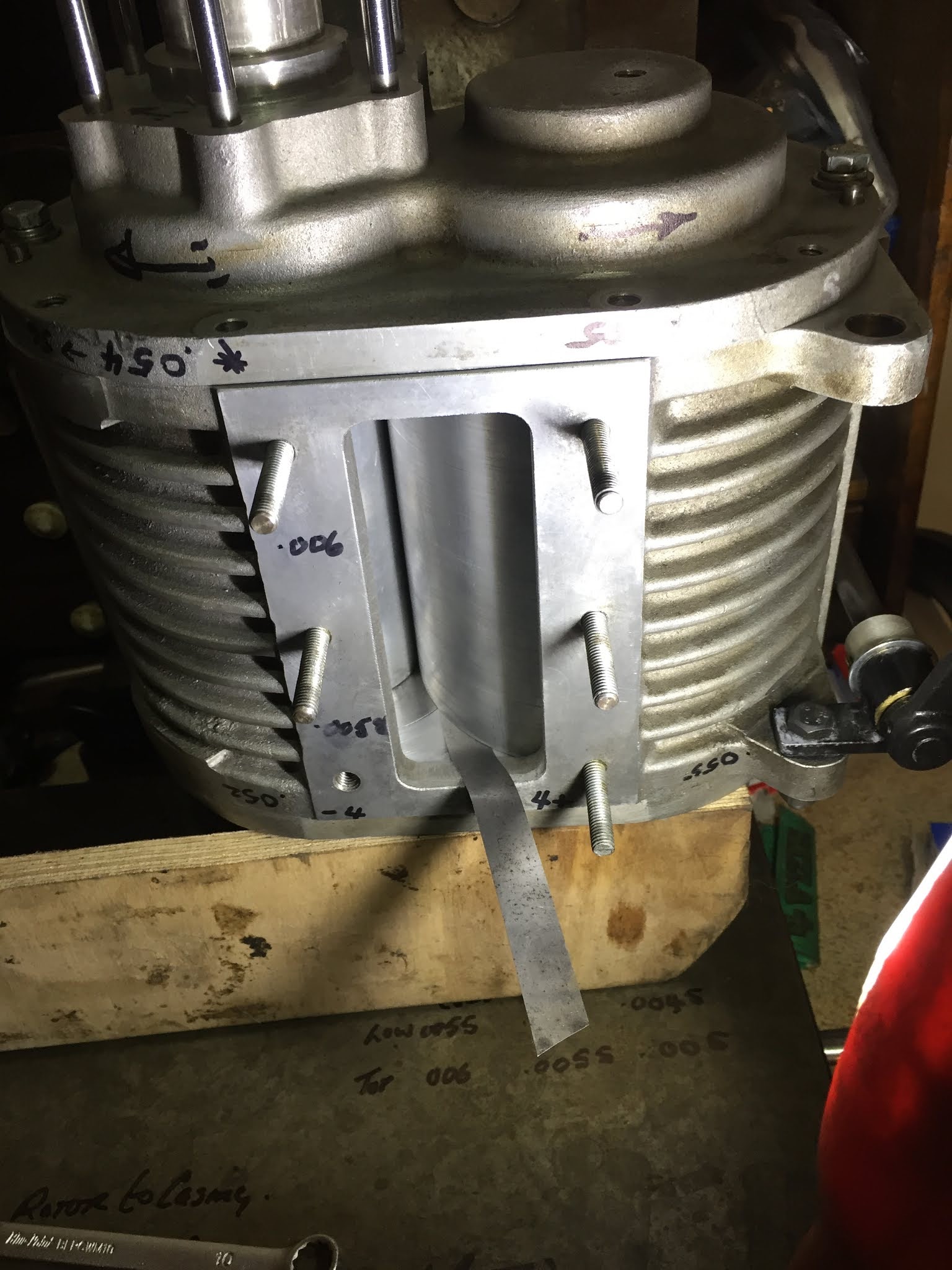
Here we have the final tests and setting of the supercharger. Although simple in operation, you can see the reason for attention to clearances. The rotor engagement and disengagement are so close, it is critical that we have the timing correct to give the full clearance available. In the video we are only doing about 500 rpm... less than 10% of the actual speed in the car!
We have set the clearances and tested them at three different temperatures, noting the results carefully to a chart. This will be an area to monitor carefully during initial test runs.
Note how my hand restricting the pressure loads the battery powered gun.
We have been waiting for one drive extension shaft bearing to complete the assembly and refit to the engine.
Please press the play arrow..

We have been working on some finishing touches, including making some new studs where necessary and making an "indexing" oil flow control to the cylinder head. It is important that attention is given to this area as the use of a sporting cam and increase of RPM will increase the loads of the valve train exponentially. The original union has a fixed restricted path.
Some new studs have been machined as well as various items that had accumulated as "to do" during the build.




After an endless period of finishing and detailing we seem to be running out of items on the finishing list and... better still, we do not seem to be adding quite as many.
The time consuming work of a restoration goes without saying but the time consuming work in a prototypical creation and restoratrion project is exponential!
We have experimented, designed, altered,adapted, fitted new designs and trialed so many components throughout and now it all comes to a point of focus as we are near complete on the rolling chassis / body (presently delayed with the post summer Lockdown regulations in Wales and latterly England) and now we are close to the engine test run.
Although we had not expected any problems we felt it prudent to run through the supercharger and generally refresh this with new bearings and any fettling that might be necessary. With new bearings and a little dressing of a few areas we can check and set the various clearances, dress the gears and reassemble a known entity. We have made a small modification to allow the oiling of the front lower bearing, although the bearings are sealed there is some evidence that this bearing might suffer from the remains of fuel and condensation which over a period ingress into the rubber seal. I can imagine that the original design of this unit may have been to pump air alone as opposed to the fuel mix it endures during its racing career. We have also made some repairs with the use of thread inserts where necessary.
The supercharger is actually not as simple to set end face clearances as you might think. The rotors are floating axially and thrust washers dictate their position in the endplate counterbores whilst the rotor end face clearance is a factor of the housing length and rotor length. A lot to consider when measuring.
All bench measurements are noted to a chart to help us to monitor the unit during the initial period of testing. We have taken the clearance measurements over a set range of temperatures to provide us with an initial reference.
The gears that mesh the rotors are straight cut... very strong, and mounted via tapers not keys. There has been some discussion in the vintage world regarding the use of tapers and the fact they might fail as opposed to a key. My own feeling is that tapers are very good, providing they are appropriate for the design loads, in perfect contact and assembled spotlessly clean (including the absence of Loctite). A taper might just provide the first point of release should something catastrophically fail within the rotor and send ever churning fragments into your engine as a drive chain or gears soldier on!
We have also made a metering unit to replace the now rare original item that controls the oil feed to the valve train. As engine speeds increase with new materials and designs, we may consider a different oiling system at a later date to ensure that the high loads induced by a sporting camshaft are appropriately accommodated by adequate lubrication.
Rizla: For generations engineers have been using the precision of Rizla papers! I am proud to pass the tradition to Jacob...




Previously we made a wind deflector for the driver's Brookland screen, as with all things on this car, we tried to make it appropriate...
