Some Bits and pieces in our late summer workshop.... please click here to open fully


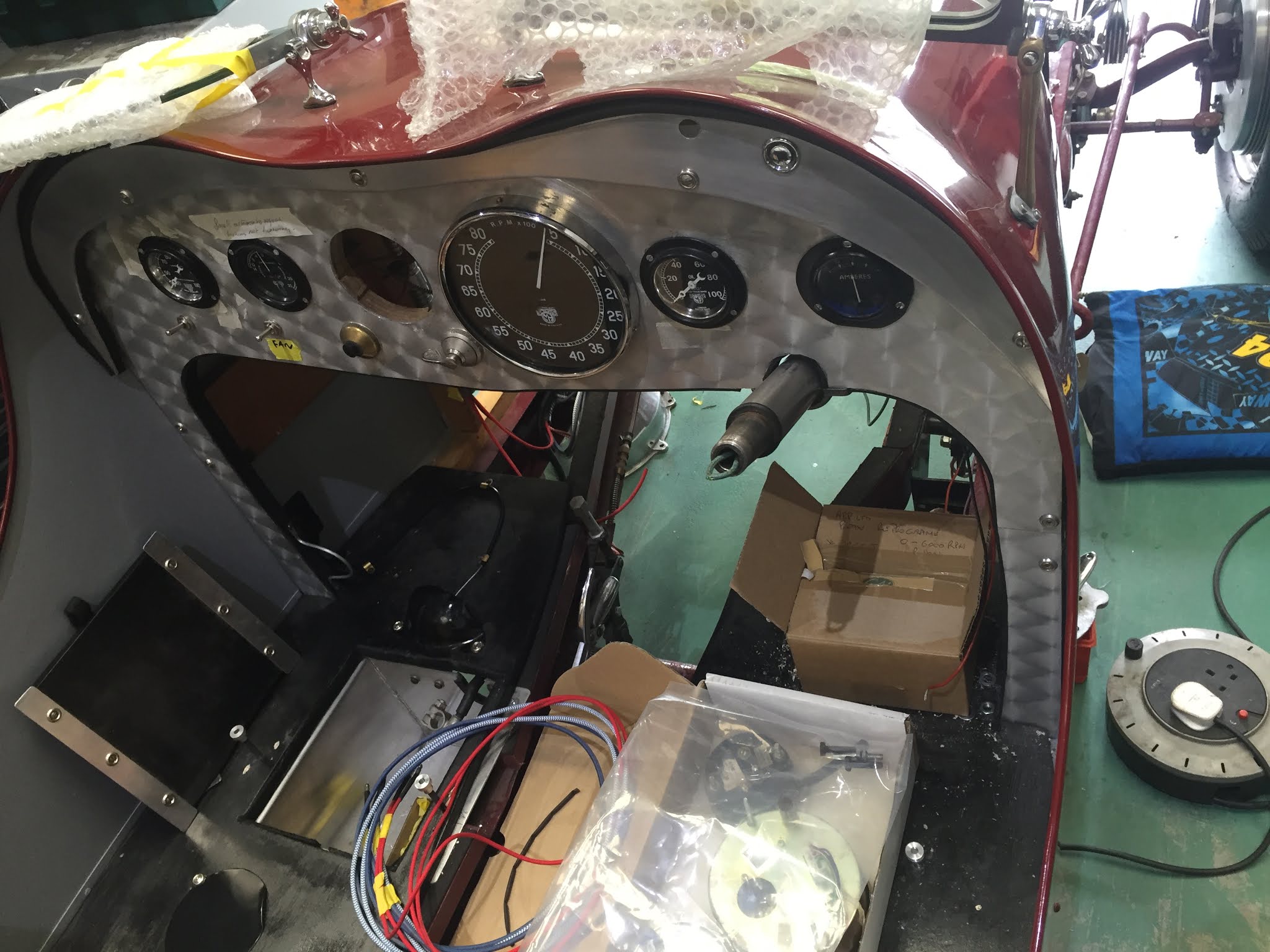
'30s Supecharged Wolseley Hornet, a million last painstaking jobs as we build this special from ground up.


Designs roughly put to paper, sometimes refined later in the evening, a must where stress calculations are necessary and sometimes created from the sketch alone.




Pre-War Peugeot. Conversion to shell bearings:

As with all modifications, we have to think of any consequences of changing the design of a mechanism. Whilst changing from white metal to thin wall shells from a later vehicle will be more practical for future builds of this engine, the cost is not any less than a full white metal replacement in this first instance.
These connecting rods have been converted many years ago and the whole engine was then stored. As as we build the engine we have to be very aware to make sure all is correct. We have had to machine and hand fettle the tang locations for the new shells. There is a small problem, as the housing mating surfaces go together they do not quite fully mate, the faces are fractionally out of true toward their edges. We now have to lap very carefully whilst keeping a watchful eye to maintain the housing tolerances within tenths of a thousandth of an inch. We mustn't forget to drill the tiny, timed oilway that feeds the cylinder bore for a very brief interval.. This is all very rewarding work, but terribly time consuming. We fettle a very small amount by filing the tang locations and lapping the face. We then apply Blue paste (similar to the use of a sooty flame in the gun making video elsewhere on this blog https://artinengineeringco.blogspot.com/2020/07/immerse-into-world-of-craftsman.html ) to the items, assemble, carefully torque together, strip, inspect and as necessary continue the process until all fit as near perfectly as possible. The whole meticulous process takes place under the vigil of an unforgiving ticking clock...


Standard Vanguard Solex Recovery. ...Please click here to open fully.


 Here we have carried out some recovery of the throttle butterfly shaft and of the worn carburettor housing. Machining the housing over size to accept an aluminium sleeve and new inner bronze sleeves as well as machine the shaft to suit. Finally all is line reamed and fettled to operate smoothly.

Mid 30's Supercharged Wolseley Hornet Special Build.... please click here to open

For a long time I have been involved in building this Wolseley into a special competition car. We have made very many bespoke items. Whilst I don't think I can post retrospective photos, here are some more photos as we move forward.
As you can see, we are set up and working toward a brief initial engine run in the workshop, this will be very brief to allow us to return to the various skew drives and other areas to visually inspect and ensure that all is well, especially in the way that they mesh together as there are so many new items that have never run with the old before. We have already "blued" with engineers blue to check the witness of engagement. We have also pressurised the oil system to prime and to check for vital leaks prior to fitting the sump. This is an incredibly effective way to illustrate any defects, including excessive clearance in new engine bearings and reground cranks.... it is all too easy to misread a micrometer despite checking many times.


With the aid of a Triumph fuel tank we have set up in preparation for a brief run.


I had initially used a section of Nylon to make an extended width chain tensioner but this was a little too thick and unforgiving, here I am riveting a section of suitable grade Tufnol onto the original tensioner. The extra width is to accommodate a duplex timing chain drive upgrade.


Smooth engagement of the oil pump was hindered by these old burrs on the coupling spline. Time for the oilstone and needle file.


The skew mechanism with the new skew gear in bronze. We have to ensure all is aligned in the brief engine run, If all ok I can drill, ream and taper pin to secure. Note the engineer's blue to provide an initial engagement witness. The steel driving gear is also new to suit.


Always be aware of raddii clearance... never take them for granted!


Here we had a small oil weep, I am checking that the assembly is now centralised and nipping the gasket. I had to carry out a metal spray repair around the cast iron inner boss and have to leave a small fillet, I have to make sure the gaskets have a sufficient diameter bore to clear the fillet and not hold off and allow the joint to weep. As you can see, we made a sleeve to help the repair from the inside. We also had to make a new shaft coupling spade, including milling a corresponding slot to allow the spade to engage and bronze weld into position.

Hornet Special (Not the Wolseley kind)..[click here to fully open]

Here Jacob is doing some engine work on Duncan Pittaway's Hornet special whilst in the care of Tim Harrison.
This wonderful, fast, raucous machine has two 1920's Harley Davidson engines!


                                                          For more about this car:


And some great photos by 

More Archives.. Delage DISS from tea chests! [please click here to open]


Ready for coachwork with Hugh Murray Renovations. http://www.hughmurrayrenovations.co.uk/


Et voila!!


Waiting...


Standard Vanguard Begins to Come Back to Life After Sleeping In a Garage For a Number of Years....[Please click here to open fully].


Almost blinking in the bright summer sunlight, the Vanguard emerges, proudly sporting a perfect gentle patina.
 
We have a number of jobs to do before we run the engine. As well as priming the oil, we have lubricated the rockers down to the cam. We have placed a little drop down the bores before turning her over without the spark plugs to raise the oil pressure.
As is often the case with stored cars, we have a starter motor issue, battery to replace and carburation / fuel system to drain and clean.
Having said that, this car has been beautifully cared for throughout it's life as it passes through two generations.
Once running we will move on to check the brakes and steering to make sure all is ready for the road.


Below: Having found some quite severe throttle spindle wear, we are about to machine to rebush and recover the housing. We didn't follow the route in the picture and decided to mount on a lathe face and angle plate combination with a counterbalance to calm things down as the chuck rotated at speed.


Supercharger Adaptation Continued.

 Some more Supercharger drive over the last two weeks. All very time consuming as the clock races as if supercharged toward Christmas!