Daimler Sleeve Valve Engine Work, From Quite a Few Years Ago!

 The following illustrates the work on two different engines, one was a complete strip and the other was remedial and precautionary work before running after many decades of storage.

Re Visit Of A Daimler Sleeve Valve Blog Post

Having lost many old blog photos from a technical fault, here is a re visit of this popular post.

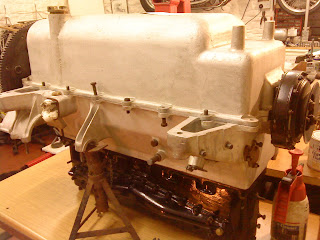
 The engine is mid 20's. It required a strip and inspection and "do what we could" within a limited budget and even more limited parts supply ...within that budget.


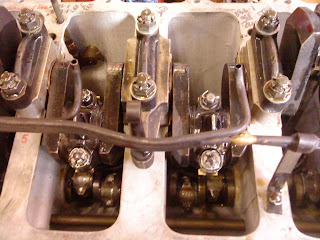
1/16 " Sleeves each has a white metal outer coating!


Manufactured Rings


Mini Crank (cam) to operate sleeve conrods. 1 for inner and 1 for outer sleeve.
Each rod has a white metal bearing!


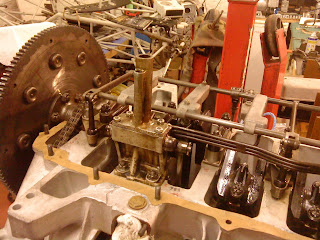
Oil pump, one plunger per dip tray and one for timing chest.


Drip tray hinges away from big end when throttle is released giving a very small "lick " at low revs.... not so good for coasting perhaps?
The main bearings are totally splash feed, something to bear in mind when starting after a long period of sitting dormant.


Long overhang of the flywheel and the drive train loads make the rear main bearing work hard. However, It is unfortunate that this overhang and a flexible flywheel (when not fitted with the heavy pressure plate), are easily lifted with a long lever during impromptu inspection or engine manoeuvring and this gives the wrong impression that the rear main bearing has worn badly even though it may have minimal wear.


Small "Wills" type rings collapse into groove. The second sleeve valve engine in the blog, used small individual head gaskets, it also had an oil pump and pressure fed crank.


Tuesday, 11 December 2012

The Auster and The Aviatrix

 At the beginning of this blog, I presented a photo of an Auster tucked up in it's extended shed Hanger in my garden. Here is some of the background as I now slowly work to building XU back to a flying aeroplane. 

Please excuse the format, I have borrowed the article back from my old blog which I no longer own [historicengineco.blogspot.com]. The article is now quite old but, although delayed, work will continue.

The Aviatrix And The Auster

Thank you Jerry Hughes
Thank you Ray Barber

Over 15 years ago I was introduced to Lisa. Very bright, tall and slim with sparkling curious eyes portraying a glimpse of something a little different.
At the time, Lisa owned a share in a Jodel G BDEH, a late 50's tailwheel aircraft, flying from a small idyllic, colonial style farm strip on the Wiltshire and Gloucestershire border.
Having spent that afternoon as Lisa's enthusiastic passenger, visiting midland airfields and welsh coastlines before cutting across the little wilderness off the Brecon Beacons. Flying at low levels suitable to dramatise the sudden vertigo prompting, dizzy drops of steep wind filled escarpments.
Throughout all of this Lisa reveled in the challenges of navigation, crosswinds and fidgety aircraft handling.
15 years later and I am all the richer for having had the opportunity to be involved in many more flying adventures where in some form or another Lisa is involved.

The list of aircraft flown and owned by Lisa is impressive and intrepid, flying her two huge radial engine aircraft, the Antonov AN2 (the worlds largest single engine bi plane) and her YAK 12 (described as a Piper Cub on steroids). Her adventurous ability beyond many pilots and comparable with the stories of the bold square jaw.....male.... pilots of the Yukon. Lisa has many adventures of flying across France (on one occasion almost shadowing my route as I delivered a customer's 30s RR Phantom to the Swiss border), through Germany and among Scandinavian coastlines and landscapes. She has survived, broken undercarriages, thunder storms, engine failures, unexpected overnight sleeps alongside broken engine aircraft and detention by over enthusiastic Gendarmes.
With an accomplished technical ability she has naturally progressed in to partnerships with small European aircraft companies, advancing deeper in to innovative light aviation industry.

You can imagine my enthusiasm when Lisa e.mailed me asking if I would be able to help with a project!
 Lisa, now living and working in Germany, arranged a meeting the next time she came home to her English cottage (a beautiful beamed cottage restored mostly with her own hands).
We met a few weeks later and excitedly I approached her first garage, the one that had memories of Lisa inviting me to view spectacular first runs of a Jet engine she had made from an old truck turbocharger and some sheet steel that she had formed and welded. I clearly remember stepping a little backwards as the leaf blower struggled to feed an insatiable appetite of the fiery, whining, crackling, moaning and shrieking monster! Oh yes, I forgot any aspirations of seeming to be macho or brave when in her company, whether flying or jet engine testing!
The garage up and over door revealed XU's 1944 de Havilland Gipsy Major engine, sitting and waiting. On to the next garage and there, amongst the DIY and building material boxes, sits G-AGXU, waiting patiently after an ignominious grounding.

Alpha - Golf - Xray - Uniform is a 1946/47 Auster J1N Autocrat. Originally designed by the American Taylorcraft company, as a light aircraft suitable for rugged short field operations and later military gunnery observation and transport wartime operations. The British Auster J1N has a 130hp Gipsy engine, upgraded from it's Cirrus predecessor. Large wings and four seats provide a robust, practical workhorse and commuter, the "Autocrat" label hinting at the intended post war market.

This particular Auster enjoyed summery days out, touring the English and European countryside under finger tip guidance of an adventurous lady pilot.
On this sunny afternoon, Xray Uniform landed serenely in a meadow and waited as her passengers went to tea (cue Ralph Vaughan Williams "Lark Ascending" music).
Do not be misled.
Like predatory pike within river bank shadows, a group of cows shading beneath English oak, clearly had other ideas. The bovine wrecking crew closed in (cue Jaws theme) and with great delight, rasp like tongues licked and munched their way through Auster fabric...not to mention the dope, woooo.

"XU" ... alone, forlorn, naked and dejected, waiting.


And so now, over a very long time, it is to be rebuilt and return to summer blue skies!


Following two days of sorting and loading X U is now safely in my workshop, applying the old adage "if you place parts of a light aircraft in to a workshop they grow tenfold"! I am sure these must be 777 wheels!


Nice above workshop picture, "Toy Box"  I think.


Some more late summer Wolseley photos

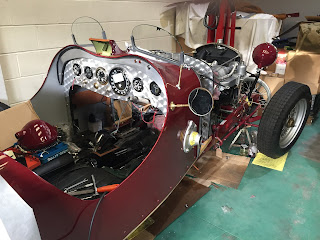
 We have been working on many small details whilst waiting for the propshaft (Bailey-Morris) and the fuel tank (Hugh Murray Restorations in Gloucestershire).

The small details become endless as we route, tidy, heat shrink and solder the wiring despite it already having been put in place last year. We have been working on the final recovery of the headlamps, a great deal of bronze welding had taken place to remove corroded sections, here we have been drilling and tapping the corroded and seized ferrous terminal fittings. Finally fitting stone guards and getting the units back into position. Jacob had worked on designing and making an adjustment setup in the early days of the project as these Ducelier lamps are not the original units, being a little smaller and a little less wind resistance!

We have dimensioned  for a cable which has been made for the rev counter, even this has taken time as we made brackets and covers for the firewall entry.

The pictures show the task of modifying a suitable mirror for the middle of the scuttle. Shortening the stem on this delicate unit was a little tricky as a new square form has been produced to enter into the base plate, we then re-drilled and tapped up through the tapered stem to accept a 4BA bolt. I had to resort to wearing two pairs of glasses to complete this in the fading late summer light... a trick I now resort to for painting, modelling and clock repairs, much to the amusement of the family. We have completed the surrounding nacelle or fairing and added a few little finishing touches with some nice brown leather to provide a little protection.

The recovery and modification of a suitable indicator switch is now complete as is the provision of a suitable warning light on the eyebrow trim section of the dash. We have also provided an ignition light and a further starter push button to allow the engine to be easily turned over from outside of the cockpit whilst attending to supercharger priming and carburation.

The outer driver's mirror mounting has been made to allow the mirror to detach easily, making room for a spare wheel when touring, this can then have the mirror mounted on to the tyre section, for racing the body mount will be used


Supercharger Adaptation Continued.

 Some more Supercharger drive over the last two weeks. All very time consuming as the clock races as if supercharged toward Christmas!